
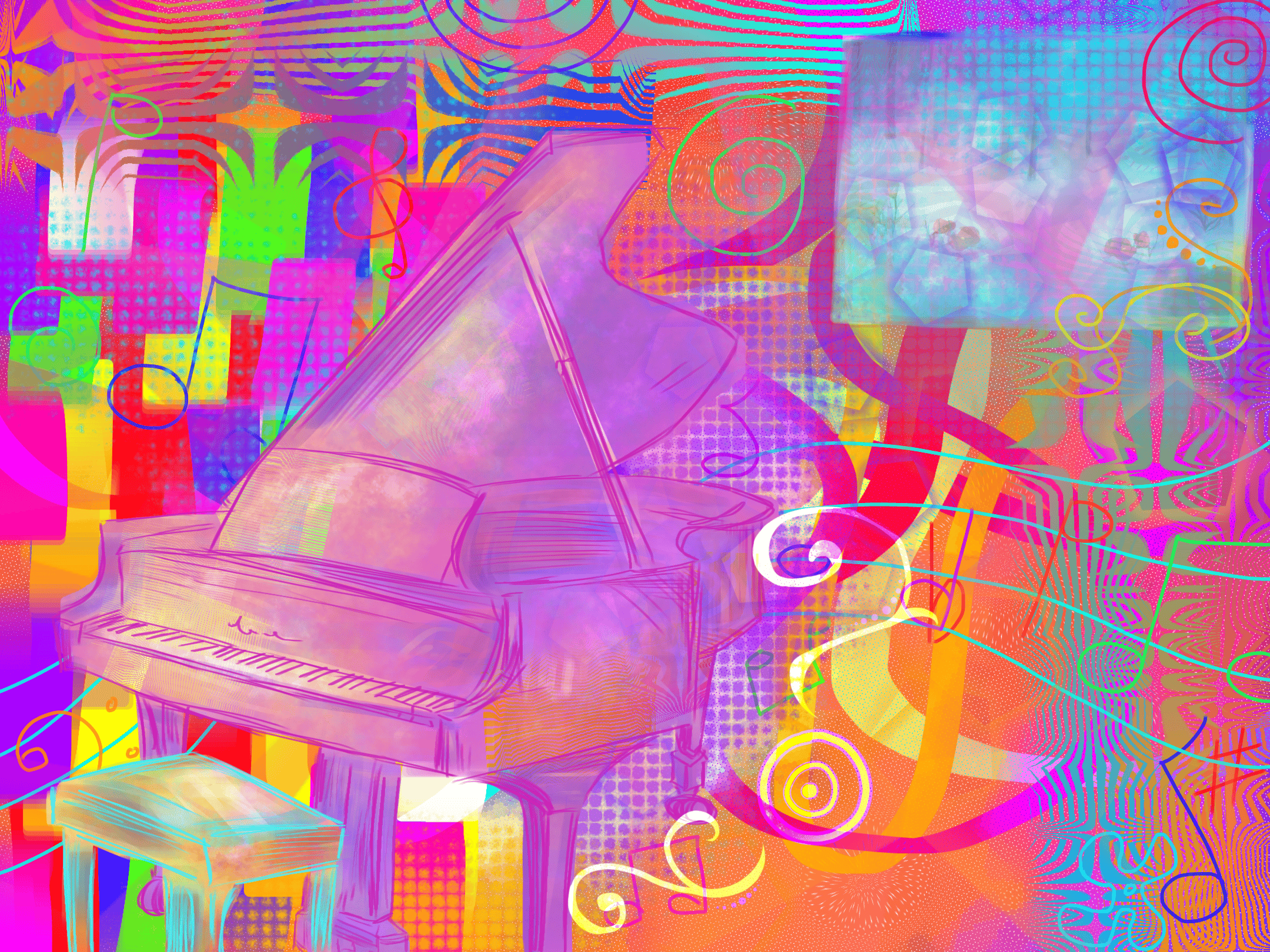
Lyric knew she had always been destined for greatness. Her parents were world-class musicians, and her grandparents, famous composers; at just eighteen, her great-grandfather had been personally invited to the Netherlands as the youngest-ever conductor of the Royal Concertgebouw Orchestra; her great-aunt was a renowned harpist who’d played for the royal family. She was descended from a line of performers. As her mother had said upon naming her sister and herself, they had music in their blood.
But she couldn’t do it. Not that she could actually define what it exactly was, but nonetheless, her music was imperfect. She was trained in ten different instruments by some of the best mentors in the world. Others called her a child prodigy, praising her delicate, refined skill and quickness to learn. But yet—it was imperfect. It drove her mad to no end.
There must be a pure, perfect form of music somewhere. She just couldn’t find it. Yet.
Her hands glided over the keys of the piano, feeling each bump, each indent between one key and the next. This piano was her pride, her most prized possession, son amour—but it, too, was imperfect. One black slab, then two, then three, then two, then three again. Asymmetrical. If only it wasn’t asymmetrical.
Sudden footsteps alerted her to another presence. Brisk, the heels clicking against the polished floorboards of the studio. She’d specifically requested everyone to leave her alone—just for the week at least—but evidently her mother had other ideas.
“Lyric.”
She didn’t need to look up to see the disapproving frown on her mother’s face, one she’d known far too many times—heart-shaped lips turned down at the corners, eyebrows slanting slightly without creasing. Though Lyric was aware she should be responding, she couldn’t risk losing her concentration, couldn’t be interrupted. She was so close, so close to perfecting her piece. She just needed more time. You always need more time, her mind whispered. She shoved the voice down. Vaguely, she heard her mother moving away, then the flip of a switch. A warm glow flooded the room, and it was only then she realised she’d been sitting in darkness, illuminated only by the silvery moonlight through the windows. Her eyelids fluttered as they adjusted to the brightness.
“Lyric. Look at me.”
She played a soft, elegant tune, but it wasn’t enough. It was beautiful, sure, but it wasn’t right. Her fingers abruptly stilled. Restart. She shifted an octave lower. This could work. It had to.
“You’ve been in here since last Friday. You need sun—you’ve already gotten paler.”
She made a distracted sound of acknowledgement, hoping her mother would leave. After all, Veria was too gentle, too kindhearted to really reprimand her. She didn’t have the willpower to yell, to truly push. As if on cue, Veria let out a quiet, mournful sigh and retreated slowly. Just as she moved to the doorway, her voice floated back to Lyric, barely stirring the air by the time it reached her ears.
“Take care of yourself, okay?”
By the time Lyric looked back up, the door had already clicked shut and the golden light of another day was starting to ebb into a dusky twilight.
.
Ever so slowly—just a millimetre’s difference a day for an extended period of time, hardly noticeable until you finally return to your senses and stare in surprise at the kilometres you’ve moved—Lyric realised, with a vague sense of horror, that she no longer remembered her parents’ faces. It wasn’t that she never came into contact with them, though they were often away for their work; instead, it was the fact that when she did, she was always so completely absorbed inside her music to really focus on their features. In this, she had effectively created little more than an indistinct abstraction, a hazy blur of colour of those she only conceptually understood as her parental figures.
It became increasingly difficult to distinguish between reality and the feverish inventions of her own mind. Sometimes, she couldn’t tell if a melody was something she had physically played, or merely a vivid ghost of her imaginings. It was an oddly thrilling, albeit disturbing thought.
For the year that followed, Lyric didn’t think she ever fully woke up from her submarine existence. Isolation and alienation were closer companions than any human could ever be, and perpetually hovering on the edges of consciousness was a far easier task than one would think.
That is, until she finally achieved musical perfection.
All at once, the world reappeared into startling clarity, with bursts of vibrant colour so saturated she had trouble looking at it—lines that defined individual objects, the sharp contrast between light and dark, chromatic aberration fringing bright edges. They pierced her monotone vision, melted her piano’s notes into a dreamlike consistency until it seemed to flow out of her star-dusted veins physically.
For those few exhilarating moments that shouldn’t have been scientifically possible, Lyric felt like she could live forever just drinking off the sound.
Once the reverie was over, when the universe calmed its frenzy and her eyes adjusted once more to the painful reality of her life, she could no longer recognise her surroundings. At some point, without her even realising, each of her family had drifted away, had lingered for a while before abandoning her to the hyperfixation that had kept her captive for so many long, lonely years. Where they were, she had no idea. All she knew now was her music, and the fact that she had never been so completely lost.
Lurching up from her chair, she stumbled over to the window; with trembling fingers, she pushed back the curtain and gazed outside. The first thing she noticed was the snow spread thick over the ground. It never used to snow here, she dimly remembered—the winters hadn’t been cold enough. The second was a tiny figure crouched far below, clad in a dark red cloak, a lone star in an empty sky. She was immediately seized by a visceral, overwhelming sense of relief at the sight of another living being; it was hard to believe she used to take such a thing for granted. Human connection! How lovely the syllables sounded in her mind, tinkling sweetly against each other as the meaning thrummed through her body.
As if in a trance, she moved back to the piano. It had been her only source of joy for so long; it felt irreplaceable. She didn’t know who she was without it. For the last time, her fingers glided over the keys, now worn and yellowed with age, feeling each bump, each indent between one key and the next with a kind of tender sorrow. She could play it with her eyes closed, knew it better than herself. Reaching up with one hand, she slowly closed the lid, went through the motions of covering it with the same bittersweetness of farewelling an old friend. Nothing had been worth it, in the end—she had sacrificed everything for nothing.
Still, she was strangely at peace.
She’d found it after all.
Writer – Romi Feng
Editor – Daniella Bremner
Artist – Tammy Ding
–September 2026–
Leave a Reply