
Winter Spent as Cato Johanson
“In three words I can sum up everything I’ve learned about life: it goes on.”
― Attributed to […]
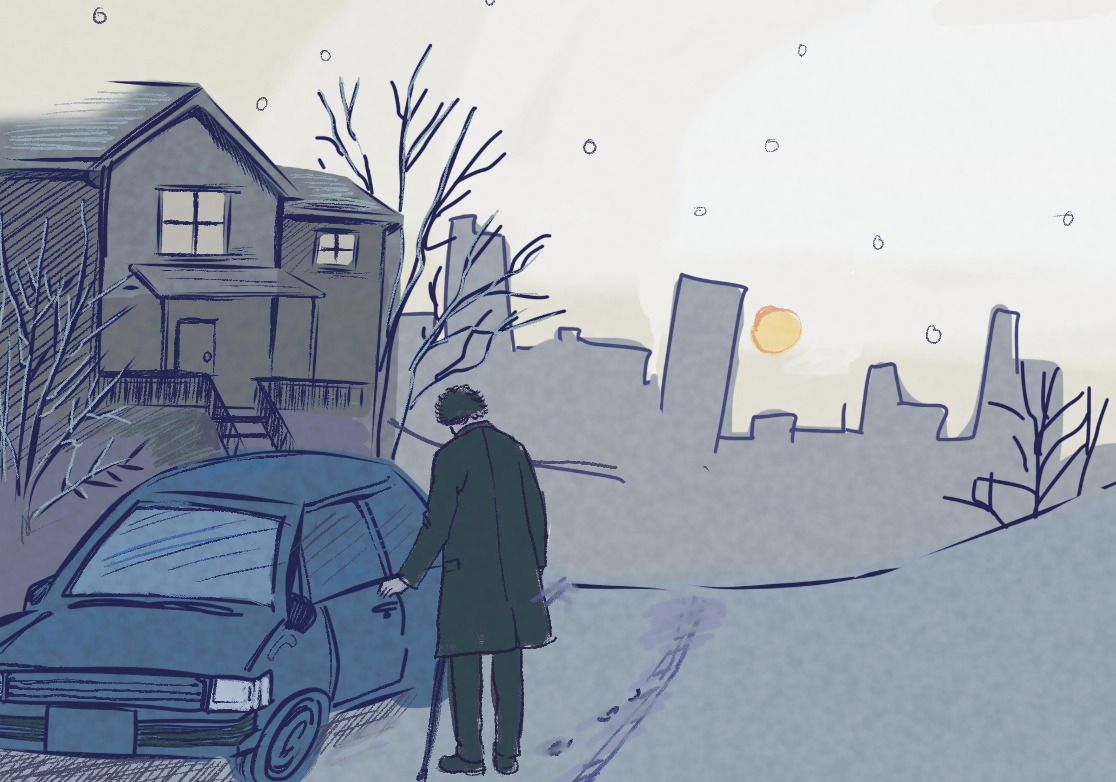
His car broke down this morning. Frost all over the windshields; the irony was not lost on him. He thought about kicking the side of it, like he normally did with the heater, but he’d like not to break his foot—nine years old, a chase through the school halls, and hours spent in the hospital only to leave a star shaped scar and a slight limp that’ll never really go away—again, thanks.
The light of the street lamps bathed his house into a glow. He barely recognised it. It called for him to go back inside, lie down awhile. But the world didn’t wait for anyone, and he has somewhere to be. Some things to do.
(Anything, he supposed—absentmindedly when in reality the thought lurked in so much of his mind, recurring like an irrational number—is better than being home. Being alone. He did not remember if he ever knew any different.)
The car gave a jerk of movement, of function, the seventh time he turned his key. It revs to life underneath his hands, and maybe that’ll have to be enough.
He dragged himself into the driver’s seat, shutting the door quickly behind him. Turned up the heater. Rubbed the side of his left calf because the thought of reaching all the way down to his toes seemed daunting. When he could feel his fingers again, he turned on the headlights—barely needed anymore, since the sun was starting to greet a new day from the other side of the horizon—and drove away.
“It’s good to see you this morning, Mr. Johanson.” One of the general secretaries for real estate agents for Fisher and Sons called out to him the moment he walked through the door at 8:12 am. Cato knew this time as ‘late-but-not-enough-for-complaints’. He supposed a man needed to take the wins he got.
“It’s good to be back, Hans.” He replied wryly, and limped his way to his office. Days this cold always made his foot acted up, and using a cane was unavoidable. Hans, bless him, between eating his croissant and buttering his baguette, scheduled his first appointment for 8:30 at the earliest so there’s no rush. Hans passed him a folder containing today’s clients, and the corner of it poked into his side. Hans gave him a guilty look but Cato waved him off.
And as much as he tried to put it off, there were many things to be done. He managed to get himself to the other side of the city before the snowing storm settled in. He found himself at the door of a penthouse of one Mr. Vasquez, Esq.
“No, no,” Mr. Vasquez denied, “I’m not a lawyer. Never completed the degree. Always was more interested in publishing. Come in, my wife’s in the other room but as long as we’re quick she won’t bother you.” The man pulled out a business card from somewhere, handing it over, “You look like a writer.” He squinted at Cato.
What did that mean? Cato wondered, but decided it was not worth the trouble. Mr. Vasquez was a long term client of their firm, but due to the man’s eccentricity it had taken almost three months to find an inspection day that could fit into the businessman’s schedule.
“If you’re planning to get your work out there, you know who to call,” Vasquez concentrated his eyes on his lanyard, “Kan-tow?”
“Cah-to.”
Mr Vasquez huffed, “Tomayto, tomahto.”
Cato, pointedly, had to remind himself not to mention the small ketchup stain on the other man’s white shirt collar.
As Cato walked through the apartment, many things came to him.
Sometimes opulence this grand makes him sick. There was excess—a hardwired tendency written into man—then there was the absurd.
The chandelier, in its crystalline glory, reflected back a ray of golden light to show its displeasure of being judged. The whole penthouse’s look—modern, sleek, wealth in clean gold and covert darks—was well put together.
Cato liked to think that considering his circumstances that he had done good for himself. That for all the things in life he might be lacking, material or otherwise, he had everything he needed.
He remembered being nineteen all over again, after his first paycheck. He got it from helping—read: writing—one of his classmate’s 23 page long dissertation. The girl had no idea that the minimum page count was only 20, never even having attended any classes besides the intro. And Cato still felt like it was yesterday, doing whatever he could to squeeze out as many words as possible without making it obvious. Back then, when words were money.
Although, to be fair, Cato had to agree with her on one thing: the class had been so dull. He was pretty sure that the lecturer ended up putting the last two months worth of lectures online simply because no one was showing up, and even then it was doubtful if anyone besides him watched them, 2x speed notwithstanding.
But then he was drawn back into the present. After all, looking out onto the city, all snow-covered, like angels, wasn’t a sight he could easily dismiss.
“Beautiful, isn’t it?” Mr. Vasquez comments, soft, underneath the current of pride. If his voice was the waves, then that sentiment was the seashells lining the shore, constantly carried off by the turbulent waves. And occasionally, the pieces find themselves stuck in the sun-baked sand. There one moment, gone the next.
“Yeah.” He cleared the cough in his throat. Cato guessed he was missing summer more than he thought. Huh. “It really is.”
They wait in front of the large window. Silence was a cold embrace.
“Shall we start with the inspection, sir?”
The only sound after that was the tapping of his cane on tile.
A hand pulled him in, about halfway through the inspection. The woman who had reached out to pull him away her mouth to brate Mr. Vasquez. Her hand was warm, and Cato wondered the last time he had felt something as simple as touch.
“Jan! You didn’t tell me we had a guest.”
“It’s a quick thing. Maria. We have to sell the penthouse, remember?” Mr. Vasquez shifted self-consciously at his wife’s gaze, “He’s with Fisher’s agency.”
Mrs. Vasquez swatted her husband’s side. “That doesn’t mean we can’t be hospitable.”
The man raised an eyebrow, “Don’t pretend like I don’t know what you’re trying to do. I know you want to hold on to the apartment, but we can’t anymore. Try not to distract Can-toh from doing his job.”
Closer, Cato thought. Good enough.
He moved away from the woman. “I hope I’m not bothering either of you too much, Mrs. Vasquez. There is only a bit more of the due process left.”
“Please. Call me Maria. The least I can do for you coming out in this kind-of weather,” She glanced at him—and at his cane, was that a flicker of pity in her eyes?—and then went back to glaring at her husband, “is make you something warm to drink. Tea, coffee? Cream?”
“Really, it’s okay—”
Mr. Vasquez nudged him with his shoulder, “There’s no point in trying to argue with her. Might as well give in now. There’s a reason I took her surname, and it’s not just because I love her.”
Mrs. Vasquez—Maria— cocked her head slyly, “I’m going to decide to ignore that comment, Jan.”
He smiled at her. “Whatever you say, dear.”
It really wasn’t necessary, and honestly a bit out-of-character for him, but Cato found himself hunched over a mug of coffee—was it two sugars and a teaspoon of milk, you said? Maria asks him, while passing the cup to him—content.
If he tried hard enough he swore he could feel the wisps of steam warming his face, even though the coffee wasn’t that hot. He took a sip. It warmed him up from the inside, almost much as the kindness of strangers did; almost as much as the couple in front of him fighting over what ‘too much sugar’ meant. Mrs. Vasquez denied such a thing even existed. Cato stifled his chuckle into his cup, raising the mug to his mouth to cover his face.
He could still see the chandelier, gleaming in the light. The drink in his hand was heating him up, finally, enough so that he could properly feel his nose again. In fact, it felt like he was shaking. The last time he remembered trembling like this was when he cried after his mother’s death, and Cato went up to brush a finger against the line of his eyes. They were bone dry.
And then Cato realised it was the ground beneath him that was uneven. The coffee splashed onto him. The crystals of the showpiece above them thrashed, and Mr Vasquez grabbed his wife and called out to him.
Something fell on him—Cato found himself on the ground, whatever above him, he could not see it if he could not see what could he do what was there to when it dug into the flesh of his thigh and the lights around them started blinking one two one two, over and over again.
All his pain blended together but there was one thing he could still make out—warmth, warm warm living blood, dripping down his legs. And the iron—he could taste it, feel the pain from where he must have bitten his cheek and his tongue—
Before the pain caused him to pass out he heard two things.
“Hey! Ca-to!” Two voices turned into one, for him, and it made him smile. Mr. Vasquez could be taught, after all. The second was the sound of thousands of dollars of glass shards flung out in every single direction, expanding ever onward.
(Later, if he got the chance, Cato would find that his thigh now as a mark to match his foot. If he ever got a chance to see it, he’d describe it as a nexus, a nebula that climbed up, up brushing against the hinge of his hip. A starburst pattern, and oh what a sight it would be.
He knew, outside, regardless, the snow fell. And fell. C’est la vie, as Hans would say.)
Cato opened his eyes in a hospital. He hasn’t been in one of these since he was nine, but he’s sure you already know that. He craned his head up, clawing his way up to a sitting position.
He saw Mr. and Mrs. Vasquez next to him, cuts and scratches on them both, and still soundly asleep.
The radio next to him was on, tuned to the news, said, “ —live from—on the anniversary of the 251st —birthday of our city—” The whirring got on his nerves and he turned it off. His eyes found the threads of the blanket on top of him, and he thought about the way they were all plaited into a piece of its own—that while the path of the individual was separate the whole was congruent.
From past the window next to him, the frost, the world continues moving. Continued turning, because it did not know how to do anything else.
“…Two roads diverged in a wood, and I—
I took the one less traveled by,
And that has made all the difference.”
— From ‘The Road Not Taken’, by Robert Frost
Writer – Areeba Zabrina
Editor – Asees Waraich
Artist – Linh Nguyen Dao Gia
–August 2026–
Leave a Reply