
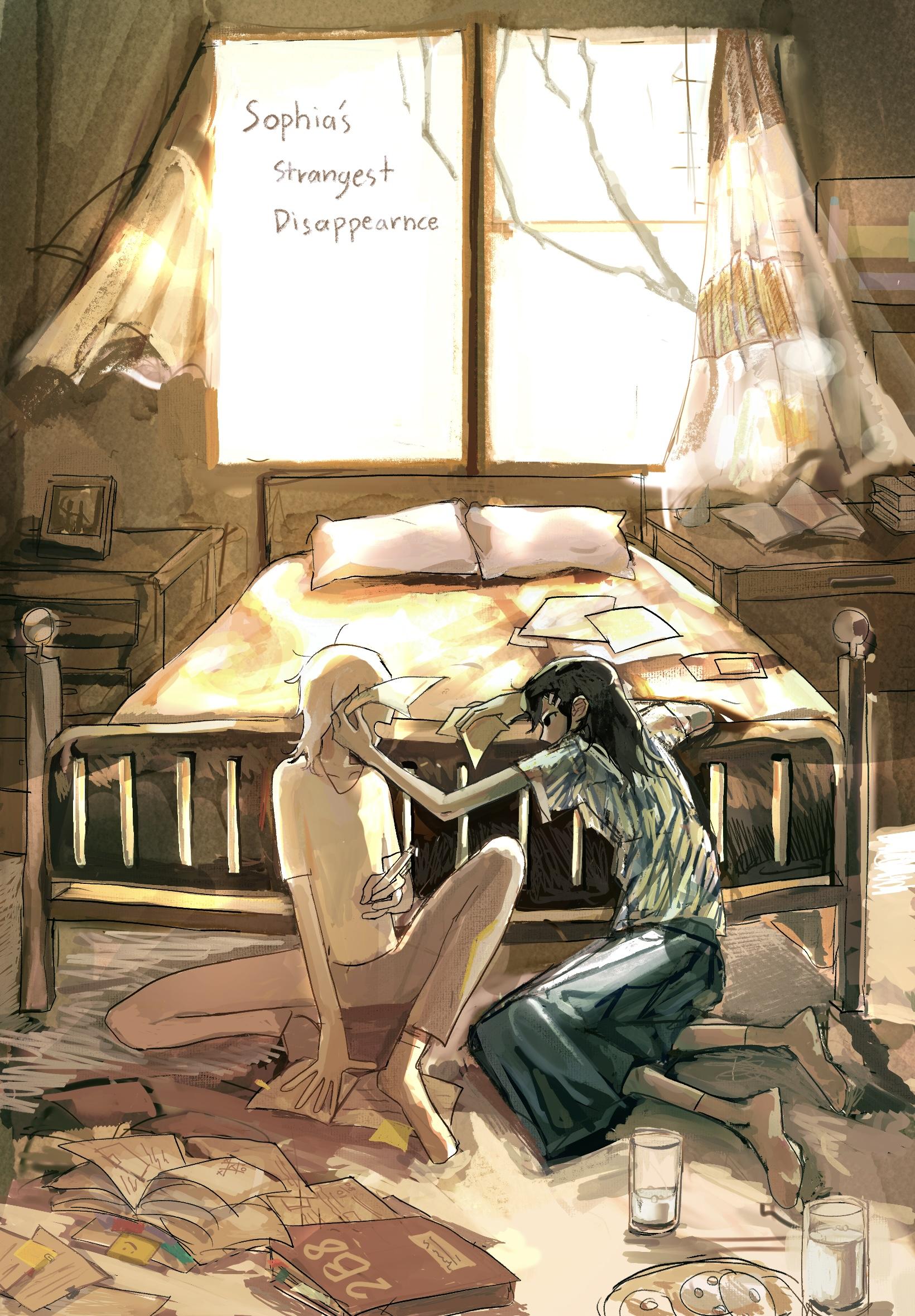
TW Depression
It was not like I could talk a lot of sense into Sophia. I never could. No one ever could. Once she had formed an opinion on something, it stuck like glue.
She would always come up with these dangerous ideas –
I want to go on a midnight walk (you’re not afraid of getting jumped? No.)
I want to go skydiving (even though you’re scared of heights? I’ll manage.)
I want to cheat on my Bio test (they could fail you. Oh, I’m already failing anyway.)
Her world revolved around her, pivoting and bending to meet her every ideal.
There were the good bits too. She believed in tidying up after herself in public spaces; she believed in saying hi to everyone we walked by on a morning stroll (even the dogs); she believed in books and literature and the truths they told. So much so that for a period of time, I was jealous of her.
But she did not believe the rest. She believed that her cat had left for good, so she did not believe in its death. She believed that she was simply not dumb, so she did not believe that she was smart. She believed that beliefs weren’t enough, so she did not believe that she had a reason to keep living the way her life was supposed to be.
So on June 4th, 2021, she decided to run.
There was no blood, no gore, no spilled life staining stone pavements, no bobbling entity breaking the iced slate of rivers, no empty medicine bottles lying still on the floors.
No. Sophia was just gone. Disappeared with nothing but herself, still in her pyjamas.
I knew Sophia for a very long time. I knew her better than her parents did. She used to be the joker at the parties. She’d sing and dance and cartwheel across the space between the kitchen and the living room like it was her stage. She was a natural singer, her tone warm like steaming stew on a winter’s day. She used to sing before the pandemic. She took vocal and piano lessons, she joined the district chorale, she sang at retirement homes.
I had a suspicion that she lost the flame of her life when she lost her voice. She had gotten the illness the quickest out of all of us, and it had hurt her throat in some irreversible way, and as her illness went away, so did the unique quality of her voice. She stopped singing. She stopped talking.
It wasn’t like there was anyone to talk to, anyway. Everyone was trapped at home in lockdown, was suffering one way or another, too busy managing their own lives to lend a hand to others. No one reached out for Sophia. It was a complete surprise when her parents called each of her classmates’ families to see if they had any information on her possible whereabouts.
She was never found.
It was as if she never existed. Her social media, appearances, or mere presence died with the idea of her in our minds. There was no indication that she was ever alive. She existed in the past, stayed in the past, and left traces of herself in our past.
She wished not to be found, and she succeeded in doing so. For the next five years, I hunted one newspaper article after another, of CLAIM MISSING CHILDREN and Unidentified Bodies. I hated that the life or death of Sophia was unclear, and until I found any trace, she would remain Schrödinger’s Cat, alive and dead at the same time.
I couldn’t find any trace. Her trick was so carefully plotted, her mischief so meticulously carried out, her mind deliberately worked against the idea of mine ever coming close to the truth.
I picked out all of our memories together and sorted them into mental containers of ‘happy’ and ‘sad’. We had a lot of happy moments. I remember each one of her laughter spells like I would remember my birthdays.
But I also remembered the sad ones. The day when she was chastised for rebuking, she wore an apology so wrong it made her face seem broken. The day when the test scores came in, her hands were squeezed between her legs so hard that they turned pale white.
The day when it rained on her flimsy jacket, and soaked through to her skin, as she sat waiting at the bus stop, waiting for her parents to pick her up, waiting for the next bus to pick her up, waiting for anyone to pick her up and lead her out of the damp and mouldy space she was in.
I imagined her in perhaps another city or even another country, living a happier life under a different name. She would smile more. She could go on as many late-night walks as she wanted, sprout wings and fly as high and as far as she could, and cheat her way through life by enjoying every second of it.
My mother likes me when I’m tidy. She told me on a Wednesday afternoon five years ago, when we were sprawled on the floor of her bedroom, packing up the Monopoly board. It was strange to think that those silly games made our whole world fun, that we had ever enjoyed such simple pleasures.
Time flies when I’m with you. She told me on a Sunday morning five years ago, when we were taking a walk, waving to strangers (and dogs). It was always when we were enjoying things that time seemed to speed up, hitting full gas on the pedal. We could never have gotten enough bouquets from the flower fields, nor enough servings of caramel pudding at the all-you-can-eat buffet. They were curtains that were so easy to pull back and expose.
I’ve never found a bigger nerd and bookworm than me, until I met you. She told me on a Friday evening five years ago, through fits of laughter interrupting her tears. Her laugh was pure – right then and there. Even though double streaks of blue were drawn onto those cheeks, even though she had never been this way again since.
Sophia, to me, was always Sophia. That Sophia wasn’t dead. Sophia had finally solved the Universe. She had transcended into a place unbeknownst to mankind. I believed that about her.
I believed that about her, so I didn’t believe that she was dead. I believed she was bright and shining, so I didn’t believe it when she took off the mask. I believed she never blamed me, so I didn’t believe that I ever blamed myself.
And Sophia was wherever I looked. On the streets, the same voice drifts from pedestrians who bump into me, muttering a quick and woeful “sorry” — before heading to where they were meant to be. On the billboards, flashing colors display fake people disguised for promotion, momentary fame soon aged and forgotten. On the subway, where every face I saw had the same eyes, same lips, same nose as hers.
And on the train that day, I caught the slightest glimpse of Sophia in the window opposite my seat. I waved at her in my brown leather jacket. She waved back at me in her brown leather jacket. I smiled and said hi. Sophia smiled and mouthed hi back. She mouthed it as she would to a stranger (or a dog) on a morning stroll.
The train kept speeding along its tracks, and Sophia and I were left staring at each other blankly.
Writer – Cynthia Zheng
Editor – Angela Wei
Artist – Khemjira Phutirat
–May 2026–
Leave a Reply