
HEINA V
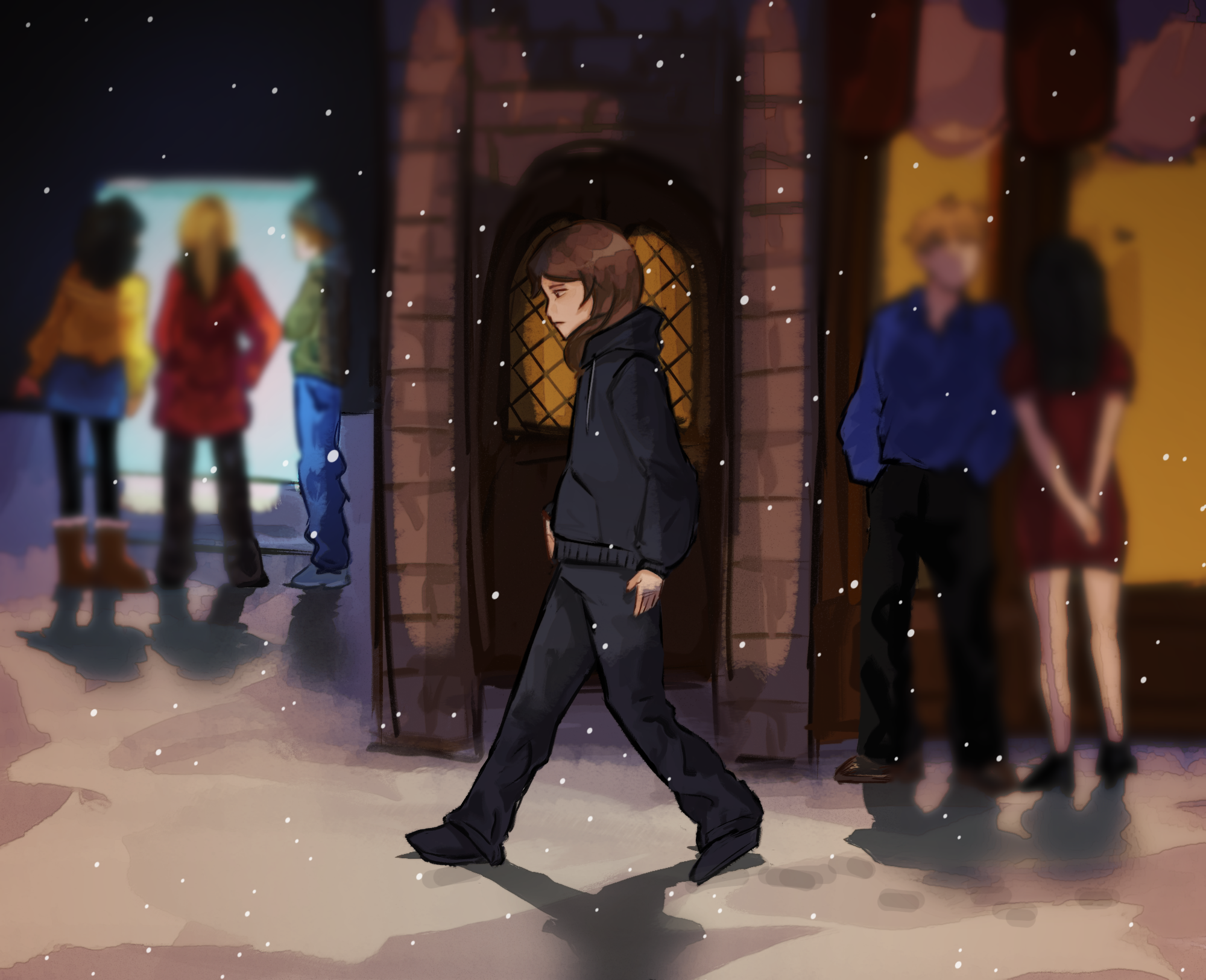
The walk home felt longer than it should have.
I had taken this route thousands of times before. I knew every intersection, every narrow alleyway between the apartment blocks, every shop that stayed open late enough for the night-shift workers to grab something on their way home. I knew which streets were usually crowded and which ones were almost completely empty. I knew where the Argus bots tended to hover, where their sensors were weakest, and which old buildings had blind spots between their surveillance routes. Heina was always predictable. That was one of the things I liked about it.
But tonight, it felt like I was walking through a copy of my own memories.
Everything was there, exactly where it should have been. The same towers stretched into the darkness, their windows glowing against the artificial night. The same advertisements flashed across massive screens, selling things I didn’t need to people who didn’t seem to question why they needed them. Cars crawled along the roads in neat, regulated streams while pedestrians moved between them, their footsteps crunching against the thin layer of frost that had settled over the pavement.
Nobody seemed to notice anything.
A couple stood outside a restaurant, laughing about something I couldn’t hear. A group of teenagers were gathered around a street display, comparing their mortality indexes and arguing about who had climbed the rankings fastest that week. One of them noticed me looking and raised an eyebrow.
I looked away.
And for the first time, I couldn’t understand why they cared. Yesterday, I probably would have. A higher number meant a better position. A better position meant more opportunities, better housing, greater access to certain areas, more respect. Everyone knew that. Everyone had grown up knowing that. It was as natural as the weather or the changing of the seasons.
Except now I knew what the number actually was.
A measurement. A prediction. A method of control.
I wondered how many of those teenagers would still care about their ranking if they knew what was underneath the city. I wondered how many would even believe me. A familiar red light passed over my face.
I looked upwards.
An Argus bot drifted above the street, cylindrical body reflecting the glow from the surrounding buildings. Its crimson lens swept over me, paused for half a second, then continued.
I froze.
It had noticed me. No. It had always noticed me. That was the point.
I continued walking.
–
When I reached my apartment, I stood outside the door for several seconds with my hand hovering over the scanner. I didn’t know what I expected to find on the other side. Maybe the apartment would be empty. Maybe every piece of furniture would have disappeared. Maybe someone would be waiting for me. Maybe the Argus bots had already been here.
I finally pressed my palm against the scanner. The door opened.
Nothing had changed.
My shoes were still beside the entrance. A half-finished glass of water I’d forgotten that morning was still sitting on the kitchen counter. My jacket was hanging from the same hook. The lights turned on automatically as I entered, bathing the room in the same warm artificial glow.
I almost laughed.
After everything I’d seen, I had somehow expected my own home to look different. It was ridiculous. It was also strangely comforting.
I walked into the living room and dropped my bag onto the couch. For a moment, I simply stood there. I could hear the faint hum of the ventilation system, the occasional movement of machinery somewhere inside the walls, and the distant noise of the city outside.
Everything sounded normal.
Then I noticed my journal.
It was open on my desk. I stopped.
I knew I’d closed it.
I always closed it.
Maybe I was being paranoid. Maybe I had forgotten. I’d been distracted enough lately that it was entirely possible. Still, I walked towards the desk slowly, almost afraid that moving too quickly would make whatever I was seeing disappear.
The page I’d been writing on that morning was still there–except the words weren’t. The ink was gone. Not smudged. Not scratched out.
Gone.
I touched the paper.
Blank.
I flipped backwards through the journal—my handwriting continued for several pages. Dates, thoughts, observations, questions. Everything was exactly as I remembered it. Then I reached the gap.
One page was missing.
I ran my fingers over the binding—nothing. There wasn’t even a torn edge. It was as though the page had never existed. My heart began beating faster.
I sat down.
For several minutes, I simply stared at the journal, trying to convince myself that I was imagining things. Perhaps I’d removed it myself. Perhaps I’d written something embarrassing and forgotten. Perhaps—
A hum came from outside.
I glanced toward the window. An Argus bot. Its crimson lens was pointed directly at me. Neither of us moved. Then the speaker crackled.
“Citizen.”
My throat tightened. The bot tilted slightly.
“You were not supposed to remember.”
The words were quiet. Almost gentle.
Then it turned and disappeared between the buildings.
I remained at my desk. I didn’t breathe until it was gone.
–
I barely slept that night.
Every time I closed my eyes, I found myself back underground. The station. The old map. The words EARTH TRANSIT. The photographs. Dr Mercer.
But above all, I thought about Plexy Lai.
I couldn’t stop thinking about the intersection. His expression. The way his number had suddenly changed. The way his body had disappeared while everyone else continued walking.
At the time, I thought I was watching someone die. Now I wasn’t so sure.
What if I had been watching someone be deleted?
There was a difference. Death was something the system acknowledged. It was built into the mortality index itself. A person could disappear, but their death was still recorded. Their name could still exist in archives. Their family could still remember them.
Plexy had been different.
His name had vanished. His existence had vanished. It was as though the system hadn’t wanted him to have ever existed in the first place.
I rolled over and stared at the ceiling.
Then another thought rushed in. How many times has this happened? How many people had disappeared before Plexy? How many families had woken up one morning with an empty chair at the breakfast table and somehow never thought to question why? How many children had forgotten parents they once loved? How many friends had simply stopped remembering someone they’d known for years?
The thought made my stomach twist.
I pulled the blanket over my head. It didn’t help.
Nothing helped anymore.
–
The following morning, I returned to the station.
I hadn’t planned to.
At least, that’s what I told myself.
I had spent the first few hours after waking up trying to convince myself to stay home. I made breakfast. I showered. I sat at my desk and attempted to read. I even opened my journal again, though I couldn’t bring myself to write anything.
Eventually, I looked outside.
The old subway entrance was visible between two buildings. And almost instantly, I knew I was going back.
The entrance looked exactly as it had before. The security tape still hung loosely across the opening, barely attached to the concrete. The warning signs were faded and covered in grime. Nothing about it suggested that the most important secret in Heina might be buried beneath it.
I stepped over the tape.
The staircase engulfed me in darkness. With every step, the sounds of Heina became quieter. The traffic disappeared first, then the voices, then the faint hum of the city.
By the time I reached the bottom, there was only silence.
I switched on my flashlight and walked along the platform.
The station looked exactly as I’d left it. Dust coated the benches. Rust had consumed sections of the rails. Old advertisements remained attached to the walls, their faces faded and distorted by decades of neglect. I passed the map.
EARTH TRANSIT.
I stopped, and this time I didn’t feel fear. I felt something closer to recognition. I walked past it and continued into the tunnel.
The further I went, the more the station changed. The cracked tiles disappeared. The walls became smooth metal. Old electrical cables ran along the ceiling, many of them still glowing faintly beneath layers of dust.
Then I saw the door. It hadn’t been there before. Or perhaps I hadn’t noticed it. There was no handle. No warning. Just a small blue symbol in the centre.
I placed my hand against it.
The door opened.
–
The room beyond was enormous.
I stepped inside and stared. There were screens everywhere. Some were broken. Others flickered with lines of unreadable code. Hundreds of cables descended from the ceiling and disappeared into the floor. In the centre of the room stood a circular console, its surface perfectly clean despite the dust surrounding it.
I approached. A blue light flickered on. Then a voice arose.
“Habitation system active.”
I froze. The voice wasn’t human. It wasn’t even mechanical in the way the Argus bots were; it was something in between.
“Identify.”
I stared at the console.
“I don’t know.”
There was a pause.
“Identity recognised.”
My stomach dropped. The console illuminated. A three-dimensional image appeared above it. At first, I barely understood what I was seeing. It looked like a city. A huge one.
Buildings stretched upwards in layers. Roads wrapped around one another. Hundreds of glowing sections formed a colossal structure.
Then the image rotated, and I realised it wasn’t a city. It was a ship. My breath caught. The structure was enormous–vast enough that my eyes struggled to comprehend its scale. And then I spotted it. Plio Street. Not too far from here.
And just as the realisation dawned on me, a label appeared.
VESSEL HEINA — HABITATION SYSTEM ACTIVE
I stared at the words. My suspicions were confirmed.
Then another line appeared.
ORIGIN: EARTH
I felt something inside me drop.
Earth.
The word I’d seen on the map. The word that had appeared in Dr Mercer’s records. The word that had felt forbidden. It wasn’t forbidden because it was dangerous. It was forbidden because it was true.
Earth was real.
And suddenly the old stories I’d heard as a child felt different. The mortals hadn’t simply vanished. They had left. We had left. We were them. I started to back away from the console.
“No.”
The word escaped my lips before I could stop it. The projection continued rotating, and another message appeared.
CURRENT STATUS: TRANSIT
Below it was a number. A distance.
I stared at it.
I understood what the digits represented, but I couldn’t comprehend the scale. It was too large. Too distant. Too far beyond anything I had ever been taught to imagine. The ‘universe’ wasn’t a painting hanging somewhere beyond Heina.
It was outside. Everywhere.
And we were travelling through it.
I sat on the floor. Dizzy.
The stories about the universe suddenly began to make sense. The stars I’d been told about in old textbooks weren’t decorations. They were places. Suns. Worlds. Systems. Entire galaxies perhaps, each containing things I couldn’t even imagine. Heina wasn’t the world.
It was a tiny piece of humanity moving through something barely comprehensible.
I looked down at my hands—
they were shaking.
–
Once I’d regained some sense of awareness, I turned toward the console again. I reached out; the archive opened, and thousands of files appeared. Some were labelled by date. Others by location. Most contained photographs, videos, scientific reports and personal journals.
I opened the oldest file, and a photograph appeared. A family stood beneath a tree.
The image I’d seen before.
But this time, I understood what I was looking at. They were standing on Earth. The tree was real. The sky behind them was real. There was no artificial lighting, no projected clouds, no numbers above their heads. Just people.
I stared at the photograph for a long time.
They looked happy; that was the strangest part. Not because they had everything—but because they didn’t.
Their clothes were ordinary, their house looked small, and the image quality was awful compared to the technology we had now. Yet somehow they looked more alive than anyone I’d ever seen in Heina.
I opened another record.
Then another.
Earth’s downfall had not occurred overnight. Multiple records described decades of environmental collapse, resource shortages, political instability and conflict. Humanity had tried to repair what it had damaged, but eventually the planet became increasingly difficult to inhabit.
So the solution was evacuation.
Massive ships were constructed.
Not enough for everyone.
That sentence stayed with me.
“Not enough for everyone.”
The first departures were chaotic. Governments chose who could leave: scientists, engineers, doctors, workers, children. People with skills deemed necessary for survival, but millions remained behind.
I closed the file.
For a moment, I couldn’t continue. We had been taught that the mortals were primitive. That they had destroyed themselves. That our civilisation had emerged after theirs had ended.
The truth was far more complicated. They had tried to save themselves. They had simply run out of time.
–
The records continued.
Heina had been designed as a generation vessel. A travelling civilisation. The journey would take longer than a human lifetime, so the engineers created the habitation system. People would live inside an artificial environment. The sky would be projected. Weather would be controlled. Food and resources would be regulated.
Memories of Earth would gradually disappear from public knowledge.
Children would grow up believing Heina was their world. The plan was supposed to prevent panic. At first, it worked. People lived normal lives.
They worked.
They formed families.
They created art.
They laughed.
They argued.
They grew old.
They died.
The ship continued moving.
But the engineers had made one mistake. They assumed that if people were given everything they needed, they wouldn’t question what was outside. They were wrong.
Eventually, someone looked up.
Someone noticed the stars didn’t behave correctly.
Someone noticed the clocks.
Someone noticed that people repeated themselves.
Someone noticed that the Argus bots weren’t merely watching citizens.
They were watching for anomalies.
People who remembered.
People who questioned.
People who looked beyond the boundaries of Heina.
And so the system adapted.
The mortality index became more than a resource calculation. It became a behavioural measurement. The more unpredictable someone became, the lower their number fell. The lower their number fell, the more closely they were monitored. Eventually, the system began removing people entirely.
Plexy Lai had been one of them.
I found his file. It contained hundreds of pages. Research, warnings, messages, personal notes. He had discovered the same things I had.
The changing clocks.
The artificial sky.
The repeated conversations.
The disappearing people.
He had tried to expose the truth, and the system had labelled him unstable. Then dangerous. Then irrelevant.
Finally, it erased him.
I stared at his name. Plexy Lai. Still here. Still remembered. Even if only by me.
I swallowed.
“I’m sorry.”
It was a stupid thing to say. He couldn’t hear me. He was gone. Still, I said it.
“I’m sorry.”
–
I continued searching.
The final records were fragmented. The ship had encountered problems. Navigation systems had failed. Parts of the outer structure had been damaged. The original destination was no longer certain.
I read the same sentence several times: DESTINATION UNCERTAIN.
Below it: NAVIGATION RECALIBRATION REQUIRED.
Then: EXPECTED ARRIVAL: UNKNOWN.
My heart sank.
There was no guarantee we were going anywhere. We had been travelling for generations without knowing whether the destination was still reachable. Maybe there wasn’t one anymore. Maybe the people who had launched Heina had died centuries ago believing they were sending humanity towards a new world, never knowing whether we’d arrive.
I thought about the citizens above me. They had spent their lives believing they knew where they were. They didn’t even know they were moving. And suddenly, I understood why the system had hidden everything. It wasn’t simply about power. It was fear.
The people who built Heina had been afraid of what would happen if humanity knew how uncertain its future really was. So they gave us certainty.
A fake sky.
A predictable city.
A number to tell us what we were worth.
They had taken away uncertainty. And in doing so, they had taken away choice.
–
I found what looked like the administrator controls.
My hands hovered over the console. There were several options;
RESTORE HISTORICAL ARCHIVE.
DISABLE MORTALITY INDEX.
DISABLE HABITATION RESTRICTIONS.
RELEASE EXTERNAL ENVIRONMENT.
I stared at the last option.
External environment.
The real sky—the real universe. My heart started pounding. I could expose everything. I could make every citizen see what I had seen.
But then I imagined what would happen. People would panic. Some would refuse to believe it. Some would be furious. Others might blame me. Children would ask their parents why they’d been lied to. Parents would have no answers. The entire society could collapse.
I thought of Dr Mercer.
His regret.
His warning.
His belief that some truths were too heavy to carry.
And now, I understood him. He hadn’t been afraid of the truth itself. He had been afraid of what people would do with it. My finger hovered over the controls. I could leave the system intact. I could walk away. I could return to my apartment and pretend I’d never found the station. I could live a comfortable lie.
Maybe that would be kinder. Maybe ignorance really was safer.
Then I thought about Plexy.
He hadn’t been given the choice. Neither had I. Neither had anyone.
That was what finally made my decision for me. The problem wasn’t that the system had lied. The problem was that it had decided we weren’t capable of knowing the truth. And these people deserved the truth.
I pressed the button.
–
Nothing happened.
Several seconds passed, and I began to wonder whether I’d made a mistake. Then just above me, a mechanical rumble kickstarted.
The lights flickered. The screens went black. One by one, the systems powering the mortality index shut down. Across Heina, numbers disappeared. I didn’t see it happen. But I knew.
This was the first time in generations that nobody had a number above their head. The Argus bots went silent. The city stopped. My eyes were glued to the security screens as people emerged from buildings and stared around in confusion.
A man stood in the middle of an intersection, looking upwards. A woman touched the empty space above her head where her index had always been. A group of children pointed at the sky. People began talking. Then shouting. Then asking questions. So many questions.
I watched them through the screens, feeling something I couldn’t quite name.
Fear? Relief? Regret?
All of it at once.
I hadn’t saved Heina. Not yet.
I had only given it a choice.
–
The artificial sky began to disappear that evening.
It happened gradually. The clouds faded first. They didn’t move away like real clouds. They dissolved. Pieces of white simply vanished, revealing blackness behind them. The artificial blue followed. The sky darkened. People poured into the streets. Nobody seemed to know what was happening.
Then the first star appeared. One tiny point of light. Someone screamed. Another appeared beside it. Then another. Soon there were hundreds. Thousands.
The darkness above Heina became filled with light. I stepped outside.
For several minutes, I couldn’t move. I’d seen stars before.
In books. In old recordings. In photographs.
But this was different.
These were real.
The light had travelled across distances I couldn’t comprehend just to reach us. Some of those stars might not even exist anymore. Their light had simply taken so long to arrive that I was seeing the past. That thought almost broke me.
The sky wasn’t just beautiful.
It was filled with history.
Every point of light carried a story older than Heina itself. I looked around. People were crying. Some were laughing. Some were holding their children. Others simply stared.
Nobody was comparing numbers.
Nobody was checking rankings.
Nobody cared.
The entire city was now looking at the same thing. Not a screen. Not a leaderboard. Not a system.
The universe.
–
I thought about Earth.
I wondered what it looked like from space. I wondered whether the people who had left had looked back through the windows of their ships and felt the same sadness I felt now. Maybe they had been terrified. Maybe they had regretted leaving. Maybe some of them wished they could turn around.
I thought about all the people who had never made it onto the ships. All the people who had been left behind. All the generations that had lived and died inside Heina without knowing what they were travelling towards.
I thought about Plexy.
He had stood beneath this same artificial sky. Perhaps he had looked up and noticed something was wrong. Perhaps he had felt the same loneliness I felt now. And perhaps that was why he’d kept searching.
Not because he thought he could understand everything. But because he knew there had to be something beyond what he’d been shown.
I looked upwards again.
The stars seemed endless. They stretched beyond the buildings, beyond the clouds that remained, beyond the limits of anything I could see. The universe was incomprehensibly large.
And I finally understood why the system had been so afraid of it. You can’t control something you can’t measure. You can’t rank something that has no hierarchy. You can’t place a number above a star. You can’t tell the universe what it is worth.
Realisation overcame me with how small we were. And somehow, I didn’t hate it. I had spent my entire life being told that my number determined my value. That a person could be reduced to a calculation. That higher meant better. Lower meant worse. Zero meant nothing.
Now I was standing beneath billions of stars, and none of them cared about my number. None of them knew my ranking. None of them knew whether I’d been successful, intelligent, or useful.
They simply existed.
And so did I.
Maybe that was enough.
–
15th of May, 2158
I returned underground one final time. The console was still running, but most of its systems had gone dark. I looked through the remaining records. There was one file I hadn’t opened.
It was labelled simply: HEINA — FINAL MESSAGE
I opened it.
A woman appeared on the screen. She looked old. Older than anyone I’d ever seen in Heina. Behind her was a window. Beyond it was Earth. Real Earth. Blue. Beautiful. Alive. Just as I’d seen in my textbooks.
She stared into the camera for several seconds before speaking.
“If you’re watching this, then you’re probably far from home.”
Her voice trembled slightly.
“We don’t know whether you’ll receive this. We don’t know whether you’ll ever find another world. But if you do, I want you to remember something.”
She paused.
“We built Heina because we were afraid.”
I leaned closer.
“We were afraid of dying. Afraid of leaving Earth. Afraid that our children would inherit a world with nothing left to give them. We thought that if we could remove uncertainty, we could remove fear.”
She smiled sadly.
“We were wrong.”
The recording crackled.
“Fear is not always something that needs to be removed. Sometimes it tells you that something matters.”
She looked towards the window.
“One day, you may look outside and realise how small you are. You may feel insignificant. You may wonder whether any of this matters when the universe is so vast.”
Her eyes returned to the camera.
“But don’t confuse being small with being meaningless.”
The recording ended. I sat in silence. I don’t know how long I remained there.
Eventually, I stood.
–
When I returned to the surface, the sun was setting. At least, I thought it was the sun.
For once, I wasn’t completely certain. The city was quieter than usual. People moved through the streets differently. Many were still confused. Some were asking questions. There would be arguments. There would be fear. There would probably be attempts to rebuild parts of the old system. There would be people who wanted the numbers back because numbers were easier than uncertainty.
I couldn’t blame them.
Uncertainty was terrifying. But it was also real. I walked through the city without looking at anyone’s head. There were no numbers anymore. Just faces.
I passed the intersection where Plexy had disappeared. The pavement looked ordinary. People continued walking around me. For a moment, I imagined him standing there.
Not as a ghost. Not as something supernatural. Just as a person who had once existed.
I wondered whether anyone else remembered him. Maybe.
I hoped so.
I continued walking.
–
By the time I reached my apartment, the sky was completely dark again. I went onto the balcony. The city stretched beneath me, but it looked different now. The buildings were still there. The traffic still moved. The Argus bots were gone. And above everything was the real sky.
I opened my journal. The missing page was still gone. I turned to a blank one.
For a while, I didn’t know what to write.
Then I began.
I wrote about Plexy. I wrote about Dr Mercer. I wrote about Earth. I wrote about the station and the ship and the unmeasurable distance between Heina and everything else. I wrote about the stars. Most importantly, I wrote about the fear.
Not the fear of dying.
The fear of not knowing.
I realised that for my entire life, I’d been taught to fear uncertainty more than anything else. The system had promised that every question had an answer, every person had a number, every life had a place. But the universe didn’t work like that. The universe had unanswered questions. It was distances too large to comprehend, and contained stars that may already be gone. It had worlds we hadn’t discovered and possibilities we couldn’t imagine. It was an endless expanse that didn’t care whether we understood it.
And perhaps that was the point.
Maybe humanity had spent too long trying to shrink the universe into something manageable. Maybe we weren’t supposed to understand it. Maybe we were simply supposed to look.
I closed my journal.
Then I looked upwards. The stars stretched endlessly above Heina. For once, I didn’t count them. I couldn’t. There were too many.
And somehow, that felt perfect.
I wondered where we were going. I wondered whether we’d ever reach another world. I wondered what was waiting beyond the darkness. There were thousands of questions inside my head, and for once, I didn’t try to silence them. I let them remain.
Because I finally understood something the system never could.
A question didn’t need an answer to have meaning. A life didn’t need a number to have value. And the universe didn’t need to be understood to be worth exploring.
I leaned against the balcony railing and watched the stars.
Somewhere beyond them was Earth. Somewhere beyond Earth were countless other worlds. Somewhere beyond those worlds was something I couldn’t even begin to imagine.
The universe stretched on.
And so would we.
For the first time, I wasn’t afraid of what came next. I was curious. And that was enough.
I looked towards the horizon as the first light of morning began to appear.
Then I opened my journal again.
And I started writing.
Writer – Mayah Clements
Editor – Alvin Cheng
Artist – Janace Wang
–September 2026–
Leave a Reply